In a lot of ways, Ghidorah, The Three Headed Monster is the first archetypal Godzilla movie. To be more precise, it is the first archetypal Showa series Godzilla movie. What this is to say is that the routine under which the rest of the Showa series would follow (barring a couple key exceptions) began with this movie. Although it can be argued that Godzilla Raids Again, being the first movie centered around a monster battle should represent the thematic start of the Showa series, or perhaps King Kong V.S. Godzilla due to its lighter tone, it is in Ghidorah the Three-Headed Monster that the seemingly paradoxical combination of goofy, child-centric action is paired with a narrative that largely takes itself seriously, along with a Godzilla who no longer acts as a villain, but is instead taking his first steps towards herosim.
As a story, this film, which for simplicity I will reduce to the title of "Ghidorah", is interesting not because it is particularly good, nor unique as far as monster movies go, but because of the political context under which it was made. The film centers around multiple female characters who have a surprising amount of agency and importance for a movie from 1964 Japan. Yuriko Hoshi co-leads as reporter Naoko Shindo, a fact which makes this the first Godzilla movie to put the focus truly on a female lead who pushes the narrative forward along side her brother, Detective Shindo played by Yosuke Natsuki. Although nothing a contemoprary audience would take note of, in the era it was produced, this would have been unusual to say the least, and is to some extent indicative of a movie that, although not spectacular under a modern lens, is all the same competent in most everything it attempts, avoiding some of the pitfalls of previous movies while delivering an interesting narrative. This character work with Naoko is the best part of the movie outside of the monsters, as she shines both in the performance of Yuriko Hoshi, but also in the level of competence she displays throughout the movie. Indeed, one of the key themes in the film is people pointing out that she is behaving in ways that are "unladylike" or devaluing her efforts, but all the same she is the character who makes the decisions that movie the plot much of the time.
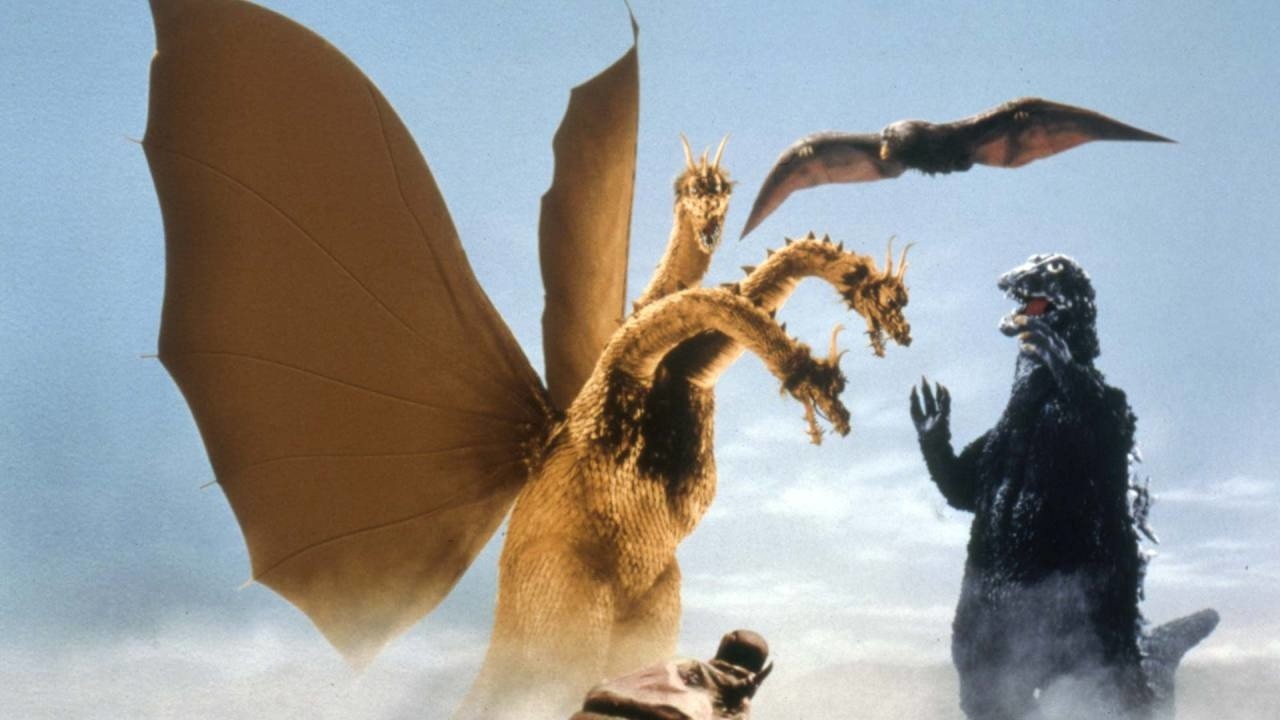
Focused on a narrative of apocolypse, the shadow covering the film is the prophetic words of a woman, princess Salno of Sergina, who claims to be from venus, warning of the arrival of a planet-destroying dragon Ghidorah. Her claims are met with skepticism by the characters of the movie, namely our secondary protagonist Naoko, but overtime (and on the back of an assassination attempt, and the reveal that the alien is posessing the form of the princess), the alien proves prophetic afterall, as the planet eater himself appears to destroy the world. This is an interesting premise for a Godzilla movie, one which would reappear throughout the series in some form or another, and Ghidorah as a monster carries real weight in the narrative, helped in no small part by how brilliant his design is. A three headed golden dragon is simple as far as designs go, but in its simplicity there is elegance, along with genuine terror with how imposing he is, towering over Godzilla and Rodan, who along with Mothra's larva from the previous movie, must team up to stand a chance against Ghidorah.
The metaphor of Ghidorah in the film is fairly obvious, and one of the more frequent currents within Godzilla movies: environmentalism. The prophet warns of a coming ecological disaster as peronsified through Ghidorah, who burns the surface of worlds, leaving behind nothing but smoldering ashes in his wake. This literalized climate change is not subtle, but all the same is effective, as presenting ecological disaster through the visage of a lightning-spewing dragon with three heads gives what is otherwise relatively abstract a real physicality. This is further helped by the overwhelming threat of Ghidorah allowing Godzilla himself to transition out of the role of humanity destroying itself, and into the role of nature itself protecting the planet from destruction. Godzilla as nature is a recurrent symbol, and the birth of this is in this movie (although at this point it is underdeveloped, and would be expanded upon greatly going into the Heisei era, but we are a long way away from that).
In terms of effects, Ghidorah has aged poorly, but this is true of pretty much all of the early Godzilla movies in some way. All told, it could be worse, and some effects are genuinely fantastic even today, such as the Ghidorah suit itself. These effects are paired with some cinematic choices that are strange when looked at as a modern viewer, such as a musical section with overlapping visuals starring The Peanuts as the Shobijin, but I personally find these charming, and feel that the movie would be lesser without them. These strange inclusions give the movie texture, while not becoming too confusing.
Related to effects, the Godzilla suit is a slightly modified version of the Mothra V.S. Godzilla suit, and as a result, is fantastic. Balancing fear with flexibility, the '64 Godzilla remains one of the better designs for the character, and this design is used to great effect in this film. Although an anti-hero, the scenes where we are meant to cheer Godzilla on are helped by the design having larger, friendlier eyes than its direct predecessor. Yet the angry brow remains, as does the sharp claws and spikes, which taken together make for a design which captures the character exceptionally well.
In talking about Godzilla, I would be remise if I didn't mention how genuinely funny a lot of the monster fights are, with a lot of slapstick played to great effect, giving the monsters a level of character that we haven't seen up to this point in the series. From Godzilla laughing at Rodan getting webbed in the face, to Ghidorah shooting Godzilla in the groin with his gravity beams, there are so many moments that give me a good chuckle. Its here that there is some dissonance in tone, however, as the brilliant soundtrack by Akira Ifukube, as well as the human narrative, imply a serious science fiction story, but the monster scenes suggest something more akin to a saturday morning cartoon than a series scifi narrative. This dissonance will only grow as the Showa series progresses, but at this point I don't think it hurts the movie so much as it provides an interesting contrast. Although future movies kind of fall on their face in this regard, I think Ghiorah strikes a good balance between silly monster fights and a story which takes itself seriously.
Ultimately, Ghidorah the Three-Headed Monster is one of my personal favorites in the Showa series, and more than the previous movies, sets the tone that the rest of the Showa series would follow, for better, and for worse. Although its not a ground-breaking master piece like the original, nor is it quite as solid themeatically as Mothra V.S. Godzilla, Ghidorah is a solid movie which flirts with excellence, and if the plot was tightened a bit, and the effects updated, I could easily see it topping my list of favorite Godzilla movies. Despite this, I consider it to be somewhat disappointing when compared to the heights of the series, even if it is very far from the lows. I love this movie, but it would not be the first Godzilla movie I show someone, as its quirks are an acquired taste. Still, I recommend it to anyone who loves 60s scifi jank, or Kaiju films as a whole.