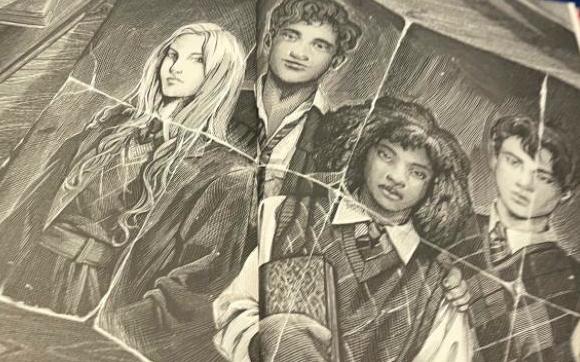
Art by Nico Delort, made for the collector's edition of Babel
After I finished reading Katabasis by author R.F. Kuang, I found myself deeply disappointed. The book, which had kept my interest through striking prose, brilliant world building, and characters solidly written enough to bind it all together, had utterly ruined my experience with an ending that managed to feel simultaneously unearned and contrived. All the same, I felt tepid excitement going into her most famous work, Babel, as the concept alone was so fantastic that I felt I was willing to look past any misgivings insofar as it delivered even a slightly better ending than Katabasis. Now, having finally had the time to finish reading it, I can say that I am not only hugely impressed, but feel that it is the best book I've read of the 2020s. But more than that, Babel represents the rare instance of a story which presents such a pointed criticism of me, its reader, through one of its main characters that I am left with feelings of shame and reverence. This book spoke to me more than any other book published in the last decade, or perhaps the last 2 or 3 decades. Its narrative of colonialism, guilt of the marginalized who are afforded opportunity in that colonialism, and ultimately the violent consequences of this colonialism, forced me to grapple with the reality of my own status as a marginalized person benefiting from the violence I am relieved from seeing. Worse though is that I am not a Robin, or Ramy, or even a Victoire, all names you will come to know by the end of this review, or if you take my advice to read the book first; instead, I am a Letty, and I am deeply ashamed to say that, yet as I write this now, I cannot deny that Letty's actions are the ones that I would take, even if I'd like to imagine myself just.
I'm going to be discussing this book, and its events at length, and as such, please take the time to read it before continuing. If you already have read it, then keep on reading, or if you have no interest in reading it, keep on reading, but otherwise, stop now and find a copy to read. It's not an expensive book to get, and is readily available. With that said, enjoy my Ruminations.
Babel exists in a fantasy version of 1830s England, taking place primarily in Oxford University in the fictional Babel school of translation. See, in the fiction of Babel, magic exists in the gaps in meaning between translated words engraved into silver bars. To illustrate, take a matched-pair used in the story, the English Parcel, and the French Parcelle. In original French and English, Parcel and Parcelle referred to small subdivisions of land, as well as letters, but in English this part of the meaning faded, leaving only a reference to something which is shipped like a package or letter. Thus, carving Parcel and Parcelle on either side of a silver bar causes objects that are shipped to weigh a subdivision of the weight that they otherwise would, through the semantic gap between the English and French. If this idea for a magic system sounds as cool to you as it does to me, you are likely as much of a language nerd as I am, and I say again, please read this book before continuing forward in this review. The potential of this magic system is achieved beautifully in Babel, and I frequently found myself between bouts of reading trying to imagine matched-pairs of my own (and was very impressed to find that sometimes my ideas even ended up being used later in the book!). In this, I immediately was drawn into not only the system itself, but the emotional state of the scholars who are introduced to the reality of it. I so thoroughly understood the conflict within our principal characters as I know very well that such a system would have excited me like few others, and even in the real world where magic doesn't exist, I still use computers and computer programming with the same zeal I might have with silver; both being dependent upon extractive industries, and in this I feel the draw of Babel, the draw of the computer, and the truth of who I am.
Babel consists mostly of third person limited chapters following Robin Swift, a half-Chinese, half-English immigrant forced from his home of Canton by a professor at Oxford named Lovell (who is also Robin's father). Early on, Robin is told by Lovell to pick an English name for himself, which is "Robin Swift". Not once in the book do we ever hear Robin's birth name. Robin as a character is split in two by his father, who demands grateful obedience, as he had his life "saved" by Lovell when he used a matched-pair of silver to protect him from a cholera outbreak that killed Robin's mother. This act was not born of kindness, but self-interest in the English crown, as Lovell had been having sex with Chinese women in the hopes of breeding a perfect scholar for Babel to introduce another language into Babel's repertoire, as the more a language is used, the weaker it becomes when used in magic. Thus, Lovell had sired at least 2 children, Robin, and later to be introduced, Griffin, in the hopes of creating this new avenue of magical development and to strengthen England's position in the world as an empire. Thus, Robin is conflicted throughout the book between knowing that the life of luxury and scholarship he has from Oxford is perhaps greater than the life he would live in Canton, yet in that world, his mother might be alive, and he would be with his people, and not denigrated as a foreign parasite by the very people who are using his skills at translation to attack his own countrymen in China. This duality within Robin is paired with sections of sheer bliss as he experiences all the wonders of being a scholar, and of academia, which tempts him in a sort of Faustian way, drawing him into the arms of a murder machine that must consume to survive.
Each "book" of the text, which acts as something of a volume of books, is paired with a section which is in the perspective of one of the other 3 protagonists of the story, Ramy, Victoire, and Letty, all save Letty being immigrants to Oxford who are in the same exploited position as Robin.
Starting with Ramy, who is an immigrant from Calcutta and a Muslim, as well as Robin's closest friend. Ramy was from a wealthy family which lost its position when England conquered India, causing his family to be effectively "owned" by the Englishman named Sir Horace Wilson, who saw in Ramy the potential of a great translator. So, he took Ramy at the age of 14 to Yorkshire, where he was trained tirelessly in language and translation, and ultimately sent off to Babel for study.
In so many ways, Ramy is what Robin isn't. He's outspoken, confident, charismatic, funny, and imprecise. He translates in wild frenzies of passion, and has a natural talent that none of the other principal characters have. In this way, Ramy is the ultimate "mad scholar" archetype, and next to Victoire, faces the worst of the abuse from English society. Where Robin and Letty can blend in due to their pale skin, Ramy is brown, and his inability to pass as white is a constant source of conflict in the narrative. He can't go anywhere safely without Robin there to grant legitimacy to their presence, as unless one were to look close enough, Robin looked more like his father Professor Lovell than a foreigner. Thus, despite their closeness, Robin can never fully connect with Ramy on the level Victoire, a black woman from Haiti, stolen away and trained in France, could.
Victoire survives. This is the most fundamental aspect of who she is and how she sees herself. No matter what, she must survive. Through brutal racism in a country freshly abolished from slavery, among academics and students who all seemingly would have liked it better if she were a slave, she is forced to exist in a hostile world. Alongside her blackness is her womanhood, which presents a constant threat, as men belittle, harass, and use her for her gender. She is the most isolated of the three, as she must face not only the intense sexism of 1830s England, but a world that would like to trap her in the bonds of slavery. This non-whiteness is what separated her most from her closest friend and ultimate betrayer, Letty.
Letty does not know what it's like to be abused for her race or nationality. She's English, and her only place of marginalization is her gender, which she has deftly conquered in much of her life. To her, Babel is a barely ambiguous good, and colonialism an unfortunate but necessary step on the way to progress. She is the most different in this group of difference, as she is white and English, and in her whiteness she cannot fathom the world of Robin, Ramy, and Victoire. To her, to give in to revolution and justice is to lose all the hard won victories she gained over the misogyny of the world. She is no doubt remarkable in her ability to succeed despite the shackles society places on women in the 1800s (and today), but still all her successes are mundane in the face of her friends, especially Victoire, who knows not only what it is to be a woman, but to be a woman of color.
Ultimately, Letty is forced to choose between an exciting future in the life of the mind, where she could carve out a place for herself as a woman in scholarship, or justice for her only friends, and for the marginalized under the boot of the English empire she loves. She chose the empire, and at the cost of the man she had come to love, Ramy. She betrays her friends to the English police, and shoots Ramy dead. Instead of fighting war and colonialism with her friends, she accepts the inevitability of the imperial, and lets her friends and her love pay the price.
It's here that I find myself uncomfortable, as I am a scholar, and someone who was seemingly born for academics. I have loved academia, I have loved learning, allowing myself to be consumed in the thrill of discovery and mastery. I am a marginalized person, I am a woman, I am Jewish, I am LGBTQ, yet I know that it is not my Jewishness, my womanhood, or my place on the LGBTQ spectrum which most defines me: it's my love of knowledge, and the academia which has afforded me the opportunity to learn.
I know what it's like to be different. I know how it is to be looked at with disgust and hatred for things that I cannot control. I know what it's like to have the language of my family (Yiddish), to be looked at with suspicion and ultimately rejection. Yet, I am less Jewish than I am an academic. I would like to look at Letty's betrayal and know with complete confidence that I would never; that I would see my friends' suffering greater injustices than I would ever even have to consider, and I would join them in their struggles, even if it meant abandoning the comfortable life of the mind. But I know I wouldn't. If revolution came to my door, I would shut and lock it, and wait for the smoke to blow over before I opened it again. I would stay huddled by my books, my dog, my cat, my fiancé, and wait for the fighting to go someplace else. Someplace I don't have to see. And even in seeing myself so horribly reflected on the pages of a book I've loved, I know that nothing has changed, and likely ever will. I am comfortable with injustice if I can read while it happens. I don't like this revelation about myself. I don't find comfort in knowing that I will always find myself comfortable. I want to be Robin standing in the Lobby of Babel, preparing to make the ultimate sacrifice for the liberation of those under the boot of the imperial and the colonial, or Victoire, surviving in a hostile world for no other reason than to fight it tooth and nail so it becomes just that little bit less hostile, or Ramy, the brilliantly frenzied in compassion and passion in equal measure, losing everything to protect my friends and the battle for liberation. But I am Letty, gun in hand, ready to destroy anything that disrupts my comfort and my silence. In this way, I reject the notion that I am not white because of my Jewishness, even as I know I bear plenty of the "stereotypical" characteristics of other Jews. Because even as I am othered by my ethnicity as a Jew, I am protected by my white skin, and dirty blond hair, and blue-green eyes. I am afforded the chance to be comfortable, to know that if a police officer pulls me over, he won't know that I'm Jewish, and even if he did, he probably wouldn't care. I am protected by the whiteness, in the same way Robin was protected by the appearance of whiteness. Yet unlike Robin, I can escape into the silence of knowing that for the majority of those in my society, I am white, and I don't have to worry about this perception being torn from me as he did. Robin at any moment could be noticed for the Chinese immigrant that he was, but I am an American living in America, born in America, with white skin, blonde hair and blue eyes. Apart from a genetic test showing my connection to the Levant genetically, you may not ever know I'm anything different than any other white person, and unless you removed my underwear, you'd never know I was anything other than a normal cis, endosex woman. I pass exceptionally well for a cis woman, and my being intersex is not something anyone but my doctor and my fiancé are even likely to learn. I, like Letty, do not have to fear the hostility of a society that seeks to destroy everything that makes me me. I, like Letty, am comfortable in the active oppression of my neighbors. As people with brown skin and the wrong last names are torn from their homes and sent off to camps for deportation to war-torn parts of the world they have no connection to, I am sitting comfortably in my plush chair typing away on my expensive keyboard, sipping on a Kirkland brand energy drink, listening to an album I enjoy on speakers connected to a computer built with materials mined from places I may have never heard of, by the calloused hands of those oppressed by the empire that I support and benefit from. God bless America. I do not rise to action, and defend my neighbors. I do not join a revolution to stop injustice. I don't even think such a thing is a good idea or even ethical for the reasons I have so clearly explained throughout the opinion pieces on this blog. Words no doubt Letty herself would say given the opportunity. Some words she herself did say. I am a villain of Babel, and I don't think this is going to change. All I can do is declare that this book is brilliant, and I am not.
References
Kuang, R. F. (2022). Babel: Or the necessity of violence: An arcane history of the Oxford Translators’ Revolution. Harper Voyager.
BRIEF ADDENDUM: I think I slightly mischaracterized myself here, in that although I am selfish with regard to supporting global liberation over my own comfort, I would not have done exactly what Letty did near the end of Babel. This is primarily due to my emotional attachments to Isaac (my fiance), my close friends, and my relatives (i.e. my family), and would die for all of them without hesitation if it were necessary. Not that it would be necessary in my fairly cushy position in life, but were it ever to, I have no doubt that I would. I cannot say the same for global or even national justice as a whole, though, thus making the self-criticism still valid.
Back